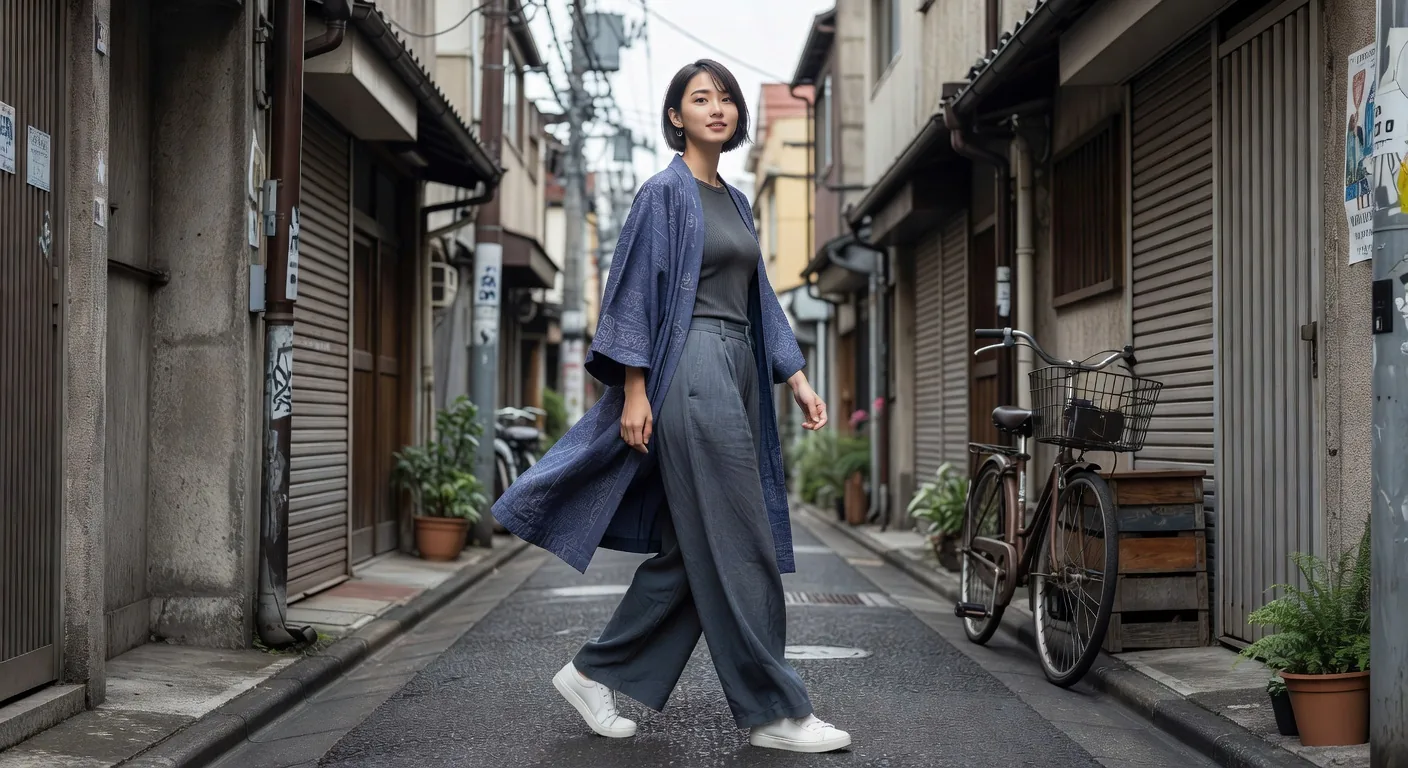
Japan's contemporary lifestyle is a study in elegant paradoxes: ancient rituals performed in gleaming modern cities; hyper-efficiency coexisting with meditative slowness; global influences filtered through an unmistakably local sensibility.
Understanding modern Japanese lifestyle means holding multiple truths simultaneously. The same person who commutes on a bullet train may spend their Sunday afternoon in a centuries-old teahouse. The city that invented the vending machine that sells hot soup also has neighborhoods unchanged since the Edo period. These are not contradictions — they are the texture of life in Japan.
Fashion
Japan's fashion landscape ranges from the strict formalism of traditional dress to the wildly experimental youth subcultures of Harajuku and Shimokitazawa.
Food Culture
Japanese cuisine is the world's most Michelin-starred — and also the culture that brought us convenience store onigiri as an art form.
Wellness
From the onsen tradition to forest bathing (shinrin-yoku), Japan has long understood the body's need for water, nature, and stillness.
Nightlife
Tokyo's jazz bars, Osaka's standing izakayas, and Kyoto's refined cocktail dens each tell a different story about how Japan experiences the night.
Fashion: Between Tradition and Experimentation
Tokyo is one of the world's great fashion capitals — not because it chases global trends, but because it generates its own. The city's fashion landscape is layered and contradictory: high-end department stores in Ginza stocking Issey Miyake and Comme des Garçons sit minutes from the thrift stores and vintage boutiques of Shimokitazawa, where young Japanese designers develop their aesthetic vocabularies outside the commercial mainstream.
Japanese fashion is distinctive for its relationship to craft. Designers like Issey Miyake approach clothing as sculptural problem-solving — how to fold fabric so that it holds shape without wire or stiffening; how to create a garment that is simultaneously a piece of wearable architecture. This tradition connects seamlessly to centuries of kimono making, where the folding and draping of fabric was itself a sophisticated art form.
"In Japan, getting dressed has always been a form of philosophy. The choice of fabric, color, and form is a statement about one's relationship to beauty, season, and society."
The kimono tradition deserves particular attention. While formal kimonos are now worn primarily for ceremonies and celebrations, the underlying sensibility — the attention to seasonal appropriateness, the significance of textile pattern, the ritualized care of putting on and taking off — permeates Japanese fashion culture at every level.
The Art of Japanese Whisky
Japanese whisky is, in many ways, the perfect metaphor for how Japan engages with the world's cultural traditions. Introduced by Scottish distillers in the early 20th century, Japanese whisky has been transformed over a century of careful adaptation into something entirely its own: softer, more delicate, more complex, and unmistakably Japanese in its preference for subtlety over power.

The distilleries of Suntory and Nikka, founded in the 1920s and 1930s respectively, have produced some of the world's most celebrated whiskies. But what makes Japanese whisky distinctive is not any single technical innovation — it is the philosophy of production. Japanese distillers approach whisky the way they approach everything: with patient attention, with the understanding that greatness cannot be rushed, with an appreciation for the qualities that only time can bring.
Wellness: The Wisdom of Slow
Japan has some of the world's longest-lived populations, and while the reasons are complex and debated, a culture that has always valued rituals of restoration must play a role. The onsen tradition — the communal hot spring bath — is among the oldest and most pervasive of these rituals, combining the physical benefits of mineral-rich thermal waters with the social ritual of bathing together in a spirit of shared vulnerability.
Shinrin-yoku, or forest bathing, has more recently captured global attention. The practice is simple — walking slowly through a forest, engaging all the senses — but its physiological effects have been extensively documented: reduced cortisol, lowered blood pressure, enhanced immune function. Japan's forest coverage (nearly 70% of the country) makes this form of wellness not just culturally embedded but environmentally inevitable.
Nightlife: The Japanese Art of the Bar
The Japanese bar is one of the world's great cultural institutions. Whether a standing-room-only izakaya where sardine-packed salarymen eat yakitori and drink cold beer after work, or a hushed underground jazz bar in Shinjuku where the bartender handles whisky glasses with the reverence of a jeweler, the Japanese bar is a space of extraordinary intentionality.
The tachi-nomi (standing bar) tradition keeps encounters brief and purposeful. The jazz kissa (jazz listening café) transforms drinking into a collective act of musical attention. The cocktail bars of Ginza — where a single drink might cost as much as a restaurant meal in another country — offer the experience of a master bartender at the height of their craft. Each of these is a different expression of the same Japanese principle: if you are going to do something, do it completely.