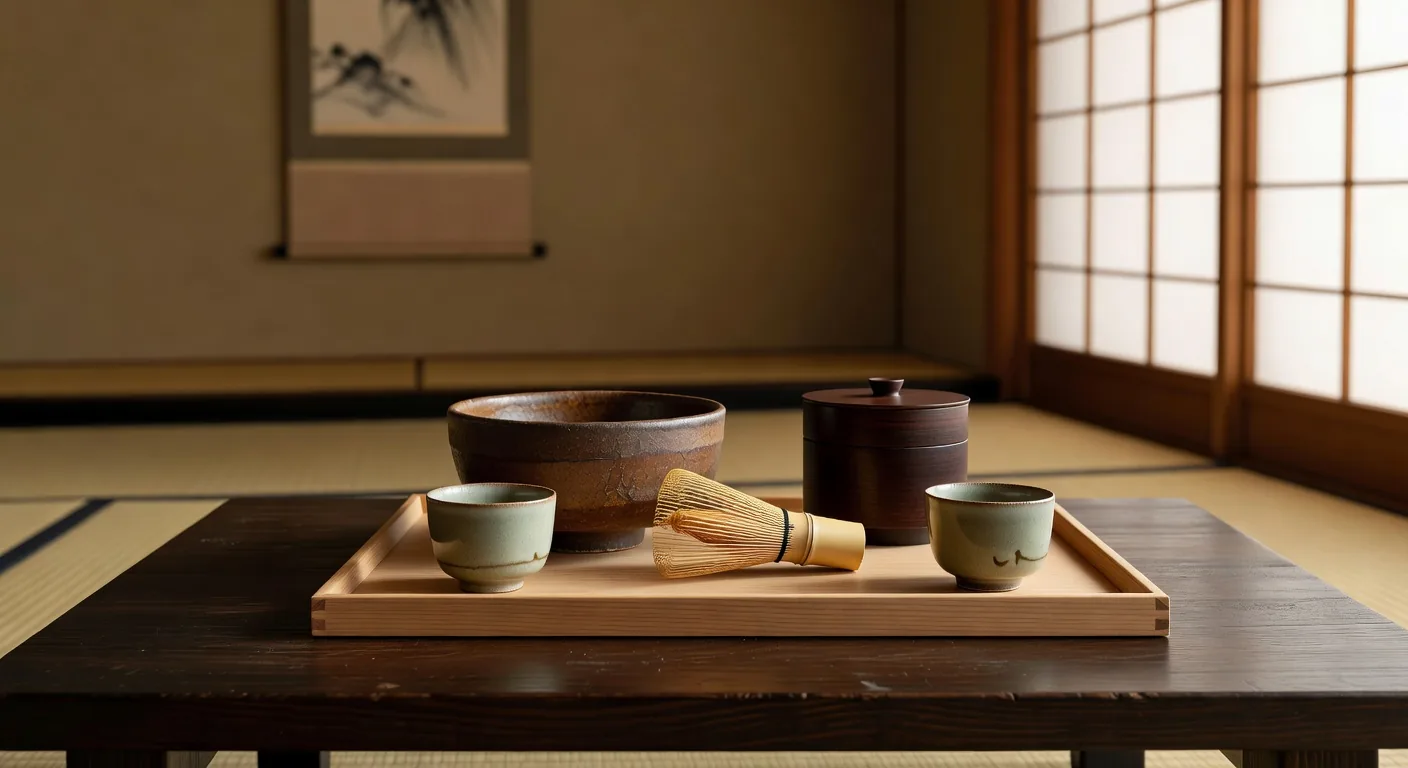
Japanese daily life is saturated with ritual — not in the heavy sense of formal ceremony, but in the sense of habitual actions performed with presence and intention. The way tea is prepared. The way a meal is presented. The way one enters a home, removes shoes, crosses a threshold.
These rituals are not merely practical — they are the grammar of a culture. Each one encodes a set of values: respect for the other, attention to the present moment, the elevation of the ordinary into the significant. To observe daily life in Japan is to witness a continuous, gentle performance of beauty.
Tea Ceremony
Four principles guide chado: harmony, respect, purity, and tranquility.
Festivals
Matsuri bind communities to seasons, ancestors, and the sacred.
Food Culture
Japanese cuisine is inseparable from philosophy, season, and presentation.
Chado: The Way of Tea
The Japanese tea ceremony — chado or chanoyu — is one of the world's most complete aesthetic systems. Developed by the tea master Sen no Rikyu in the 16th century from the Zen Buddhist practice of drinking tea in a spirit of mindful attention, chado encompasses architecture, garden design, ceramic art, calligraphy, flower arrangement, and culinary tradition. It is, as Rikyu described it, "nothing other than boiling water, preparing tea, and drinking it."
The tea room (chashitsu) is a deliberately spare and humble space — no more elaborate than a farmer's cottage, by Rikyu's prescription. The low doorway (nijiriguchi) through which all guests must crawl forces even the most exalted visitor to humble themselves before entering. Inside, a single hanging scroll and a simple flower arrangement may be the only decoration. The beauty is in the restraint.
"In the tea room, the host and guest meet in a moment of pure presence. Nothing is performed; everything is simply attended to with complete care."
The four principles of chado — wa (harmony), kei (respect), sei (purity), and jaku (tranquility) — describe not just a tea ritual but an ideal of human relation. They are the values Japan has always aspired to in its highest cultural expressions: a world in which every interaction is conducted with care and attention, and in which beauty is the natural byproduct of right conduct.
Matsuri: The Festival as Community
Japan's festivals — matsuri — are among the most spectacular in the world, but their power lies not in spectacle alone. Each festival is a moment of community cohesion, a renewal of relationship between the living and the dead, between the human and the divine, between a community and its particular place in the world.
The mikoshi — the portable shrine carried through the streets during a matsuri — embodies this perfectly. It is literally the home of a deity being brought out to inspect and bless the community. The carriers' rhythmic chanting and the controlled violence of the procession — carrying the heavy shrine at a jog, passing it between teams of sweating, shouting participants — is a physical expression of the community's vitality and unity.
Wagashi: Confection as Seasonal Art
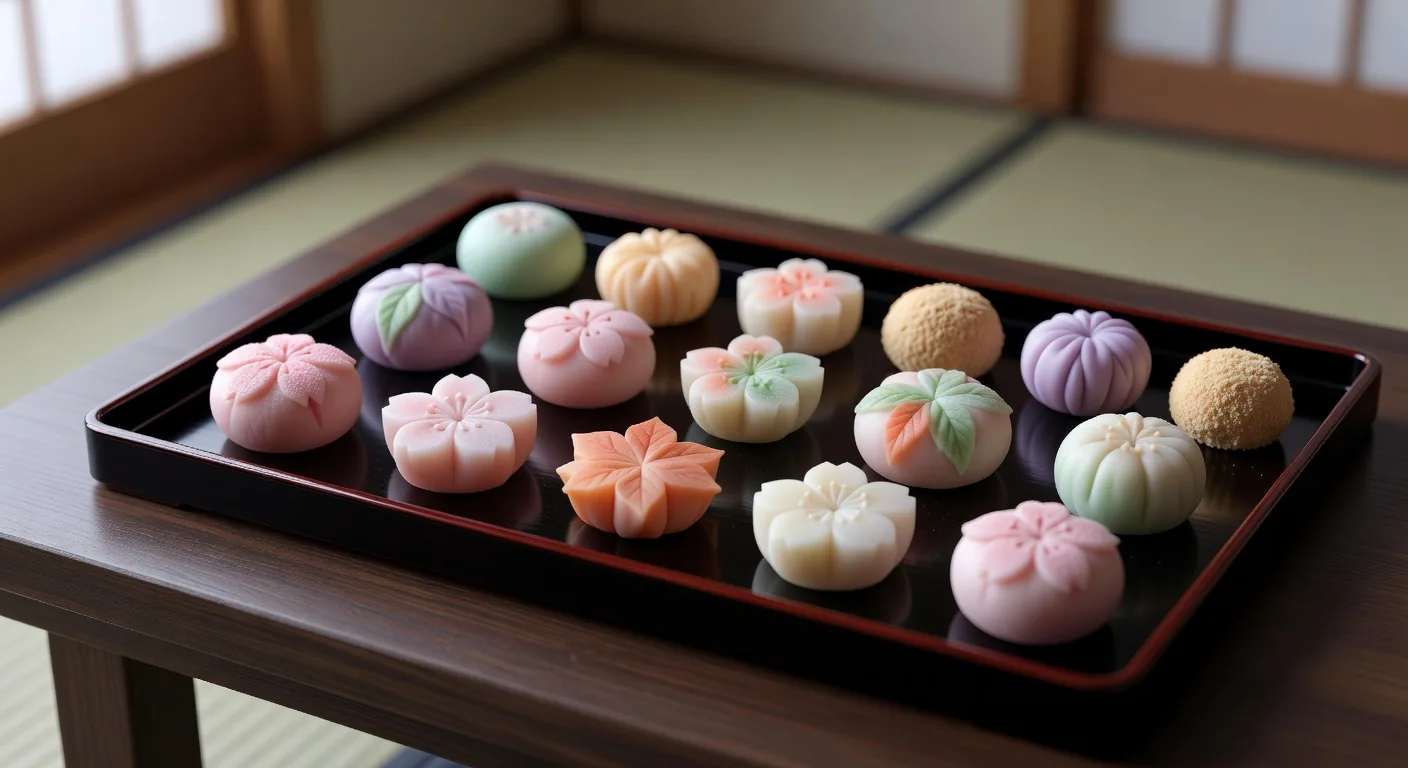
Japanese confectionery — wagashi — deserves particular attention as a cultural artifact. These sweets, traditionally served with tea at ceremonies and as offerings at temples and shrines, are miniature sculptures. Made primarily from bean paste, rice, and agar, their forms are inspired by the season: cherry blossoms in spring, fireflies in summer, maple leaves in autumn, snow-covered hills in winter.
A skilled wagashi maker works with extraordinary precision. The forms are delicate — petals thin as paper, gradients of color achieved through layering — and the flavors are deliberately subtle, designed to complement rather than compete with the tea they accompany. To eat a piece of wagashi before a bowl of matcha is to receive the season in condensed form: spring packed into a single sweet bite.
Ikebana: The Living Sculpture of Flowers
Western flower arranging tends toward abundance — the bouquet overflowing with color and fragrance. Ikebana, the Japanese art of flower arrangement, works with the opposite principle: restraint, asymmetry, and the use of negative space as an active element. A classic ikebana arrangement might include just three stems, positioned at careful angles to suggest movement, seasonality, and the relationship between heaven, earth, and humanity.
The major schools of ikebana — Ikenobo, Ohara, Sogetsu — each have their own aesthetic theories and teaching traditions, but all share the fundamental insight that the purpose of the arrangement is not to display the beauty of the flowers but to create a living sculpture in which each element — flower, branch, space, container — plays a precise and essential role.
The Principle of Ma in Ikebana
The concept of ma — negative space — is nowhere more beautifully demonstrated than in ikebana. The empty space between stems is not emptiness but air given form; it is the pause that gives meaning to the notes around it. Learning to see the space in an ikebana arrangement as a positive element, not a gap to be filled, trains the eye and mind in ways that extend far beyond flower arrangement.
This capacity to honor emptiness is, perhaps, the deepest lesson of Japanese everyday culture. In a world that insists on constant stimulus, constant activity, constant noise, Japan's cultural traditions offer a counter-practice: the cultivation of attention, the honoring of silence, the beauty that becomes visible only when everything unnecessary has been cleared away.